

2024 Adult competition
16th International piano competition of Orléans
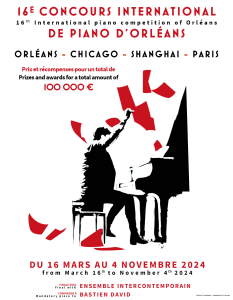 In 1994, 30 years ago, Françoise Thinat realised her dream of offering Orléans a major international piano event devoted to new music and the early 20th century repertoire.
The gamble paid off: from the very first edition, the Competition was a real unifying event with artists from all over the world, young talents who today are among the great professionals of classical and contemporary music. We need only mention that in the prize list of this first edition we find Hideki Nagano, today the official pianist of the Ensemble Intercontemporain, a legendary group created by Pierre Boulez in 1976 and which will accompany our three finalists in October 2024 in Vortex Temporum by Gérard Grisey.
If the Competition has evolved while keeping at heart the fundamental principles of the first edition, 30 years later it remains “dreamy” and still offers new challenges. This is why we are presenting a new formula: the Competition will welcome pianists from all over the world in Orléans, as usual, but it will also go abroad to meet these young pianists who will be the professionals of tomorrow: we will thus organise a first ‘nomadic’ tour which will begin in the spring of 2024 in Chicago, and will continue in Orléans and Shanghai. The candidates selected at the end of this first round will then perform in the second round, the Semi-Final recital and the Final, from October 26 to November 2, 2024 in Orléans, all in the form of a real piano festival. On November 4, the three finalists will perform at the Théâtre des Bouffes du Nord in Paris for the first time with the Ensemble Intercontemporain for a creation by Bastien David in which the three finalists will play… together!
On the artistic side, new music will, as always, be at the forefront: each candidate will be able to propose a free choice of works in his or her programme, throughout the four rounds. Not forgetting the special prizes, the new piece by Bastien David, co-commissioned with the Ensemble Intercontemporain, and the composition prize once again in partnership with Radio France. The repertoire of the beginning of the century will also have its place, notably in the final where the works of three French composers are proposed to the candidates, works marvellously recorded and interpreted by Françoise Thinat to whom I sincerely wish to dedicate this anniversary edition which would not exist without her!
In the first round, candidates will now have to propose a work from before 1900 to show how 20th and 21st century music can be associated with other repertoires and vice versa.
Once again, an ambitious, dreamy but above all smiling edition… It is with this optimism and enthusiasm that Françoise Thinat has imbued the spirit of the Competition which, thirty years later, continues to inspire its candidates, in particular thanks to the work of the team and of our wonderful association!
Isabella Vasilotta, Artistic director
————
See here the running order of the Orléans candidates.
Click here to see the brochure of the
First round in Orléans, from April 24 to 27!
Watch the First round in Chicago live:
Streaming link for March 16
Streaming link for March 17
Discover the candidates’ programmes in Chicago here.
The pdf rules of the 2024 Competition can be downloaded here
October 10, 2023 (at 2.30 pm, French time) : A one-hour webinar for pianists wishing to register for the 16th Competition. Find here the video.
December 6, 2023 Application deadline
January 9, 2024 Notification of candidates selected for the Competition
January 15, 2024 Deadline for programme modification – 1st round
January 29, 2024 Online draw (to determine the running order of the candidates)
AROUND THE WORLD:
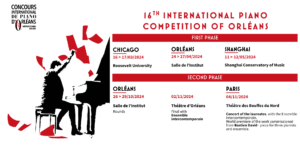
FIRST ROUND
– CHICAGO, USA: March 16-17, 2024, 3.00pm / Roosevelt University — Rudolph Ganz Memorial Hall
– ORLÉANS, France: April 24-27, 2024, 4.00pm / Conservatoire d’Orléans — Salle de l’Institut
– SHANGHAI, China: May 11-12, 2024, 3.00pm / Shanghai Conservatory of Music — He Luting Concert Hall
End of May 2024: Jury deliberation and Announcement of selected candidates
ORLEANS:
Oct. 26 – Nov. 2, 2024: SECOND ROUND, SEMI-FINAL RECITAL, FINAL
PARIS:
November 4, 2024 (8.30pm): CONCERT OF THE FINALISTS
1st ROUND:
CHICAGO
Roosevelt University
430 S. Michigan Ave.
Chicago, IL
USA
Rudolph Ganz Memorial Hall
ORLEANS
Conservatoire de musique
4 Place Sainte-Croix
45000 Orléans
France
Salle de l’Institut
SHANGHAI
Shanghai Conservatory of Music
No. 20 Fenyang Road, Xuhui District,
Shanghai, P.R.China
Zip Code: 200031
He Luting Concert Hall
2ND ROUND & SEMI-FINAL RECITAL:
ORLEANS
Salle de l’Institut
4 Place Sainte-Croix
45000 Orléans – France
FINAL ROUND:
ORLEANS
Théâtre d’Orléans
Boulevard Pierre Ségelle
45000 Orléans – France
CONCERT OF THE FINALISTS:
PARIS
Théâtre des Bouffes du Nord
37 bis Boulevard de la Chapelle
75010 Paris – France
Participation conditions
- The 16th International piano competition of Orléans will take place in two distinct stages: in the spring of 2024 in three locations around the world for the first round, and then in the autumn of 2024 in Orléans, France, for the rest of the competition.
- The Competition is open, without distinction of gender or nationality, to pianists born on or after January 1st, 1988.
- Pianists can participate in the Competition a maximum of three times. When a pianist is applying for the second or third time they must present a new programme. A maximum of two pieces already performed in previous years will be tolerated.
- Candidates are not required to perform from memory.
- Performances for the Competition rounds will be open to the public.
- In the event that candidates selected at the end of the First Round for the rest of the Competition withdraw between the end of May and the beginning of July 2024, other candidates from the First Round who have not been admitted but are on the waiting list may be asked to take part in the following rounds of the Competition in Orléans by mid-July 2024 at the latest.
Applications
-
- The deadline for applications is December 6, 2023 included (until 23.59pm French time).
- Upon receipt of the applications, only the complete files will be examined and submitted to the Pre-selection Jury who will also view the videos and pre-select the candidates.
- The Artistic Direction and the pre-selection jury will announce the list of pianists admitted to the 16th Competition. Each candidate will receive a notice of admission or rejection by email from 9 January 2024.
- Applications should be submitted on the Competition website www.oci-piano.com or via email (info@oci-piano.fr) and must include the following documents (preferably in Word or PDF format):
- Identity information and contact details of the candidate + contact details of a relative to contact in case of emergency
- A copy of your valid passport
- Two recent photographs in high definition for the competition catalogue (JPEG – 300 dpi)
- A document confirming payment of the registration fee (bank transfer certificate)
- Curriculum Vitae and biography (maximum of two pages each) – written in English (+ French if mother tongue)
- Two recent letters of recommendation, written in English or French, dated and signed by the referees, sent in pdf format. Or sent by email, directly by the referees to: info@oci-piano.fr
- A list in order of preference of the places where the candidate will take the 1st round (between Chicago, Orleans, Shanghai): 1. first choice / 2. second choice / 3. third choice
- A recent video recording (less than 6 months old) of good quality and without editing of two short pieces of opposite musical language from the 20th and 21st century repertoire (total length of the video: 10 minutes maximum). The two pieces can be recorded separately and edited one after the other in a single file.
For help on how to film this video, applicants are advised to watch the videos of the online first round of the 14th International piano competition of Orléans 2020 on our YouTube channel: Concours international de piano d’Orléans.
When sending the files, please indicate in writing the titles of the pieces and the names of the composers as well as the order of performance.
Page 5 of the Rules document, see the paragraph : *Tips for filming yourself
Only Youtube links and MP4 files (sent by email/Wetransfer) are both accepted. Please contact us if you require further technical information.- The chosen programme for the four rounds with full details and timings. For the Second round: the chosen piece for the André Chevillion – Yvonne Bonnaud Composition Prize (6’-8’) can be submitted after the end of June 2024 (name of the composer and title of the piece).
- A short statement of intent written in English (+ French if mother tongue) for the programme of the Second round and the Semi-final Recital.
- For pieces with electroacoustic devices or video (First round not concerned): a detailed list of the technical equipment (which will be sent to the Competition’s sound engineer).
- For the works for prepared piano (for each of the four rounds): a detailed list of the technical equipment (brought by the candidate) necessary for the piece, as well as the precise timing of the preparation.
=> Please ensure that the documents and files you submit are of adequate quality.- The registration fee is €100 and this is non-refundable.
It must be paid when submitting an application:
- either online
- or by bank transfer to:
Bank: Société Générale Orléans, 14 avenue des Droits de l’Homme 45000 Orléans – France
IBAN code: FR76 3000 3015 4000 0509 0641 706
SWIFT code: SOGEFRPPBeneficiary: Orléans Concours InternationalPayment by cheque only issued from a French bank account is accepted.
Do not hesitate to contact the Competition organisers if you need any help or have any questions (info@oci-piano.fr).
Only complete applications will be considered.
Discover the Call for applications for composers
André Chevillion – Yvonne Bonnaud Composition Prize – €5,000
Offered by the Foundation André Chevillion – Yvonne Bonnaud under the aegis of the Fondation de France.
- Composers (including pianist candidates to the Competition) wishing to apply for this Prize must send a complete file by e-mail (info@oci-piano.fr) including:
– three scores of their composition, at least one of which must be for piano (and recordings if possible)
– a biography and CV in English (+ in French if mother tongue)
– a short note of intent on the work they would like to compose for the Competition
- Application fee: 40€ — payable online, only from April 12, 2024, (on https://www.helloasso.com/associations/orleans-concours-international)
Important: pianist candidates registered for the 16th Competition are not concerned by this registration fee. - The registration for composers will be open on February 12, 2024. The deadline to apply is May 14, 2024 included.
Only complete applications will be processed. - The announcement of the names of the composers selected by the Artistic Direction will be made from the beginning of June 2024.
- The files of the selected composers will be made available to the candidate pianists admitted to the Second round of the Competition, from the beginning of June 2024.
Candidate pianists will contact the composers of their choice directly and will be required to inform the Competition of the name of the composer chosen at a later date. - Only one piece per composer is allowed: each composer may compose for only one candidate pianist
- This call for applications is open to composers, regardless of gender, nationality or age.
- The number of applications for the André Chevillion – Yvonne Bonnaud Composition Prize is limited to three.
- If the pianist presenting the composer’s piece should withdraw, the piece cannot be evaluated by the Jury.
Full details on our Competition rules.
Like all other awards, the Composition Prize will be announced and givento the laureate at the official ceremony following the Final of the Competition, on November 2nd, 2024.
-
04nov2024
 Concert of the 2024 laureates, in ParisParis, FranceThéâtre des Bouffes du Nord
 -
26oct2024
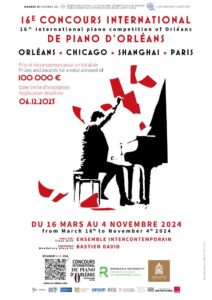 16th International piano competition of OrléansOrléans, FranceSalle de l'Institut & Théâtre d'Orléans
 -
11may2024
16th International piano competition of OrléansShanghai, ChinaShanghai Conservatory of Music
-
28apr2024
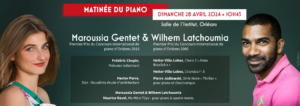 Matinée du piano – Maroussia Gentet & Wilhem LatchoumiaOrléans, FranceSalle de l'Institut10 h 45On-site and online ticketing
 -
27apr2024
16th International piano competition of OrléansOrléans, FranceSalle de l'Institut16 h 00On-site and online ticketing
-
26apr2024
16th International piano competition of OrléansOrléans, FranceSalle de l'Institut16 h 00On-site and online ticketing
-
25apr2024
16th International piano competition of OrléansOrléans, FranceSalle de l'Institut16 h 00On-site and online ticketing
-
24apr2024
16th International piano competition of OrléansOrléans, FranceSalle de l'Institut16 h 00On-site and online ticketing
-
16mar2024
16th International piano competition of OrléansChicago, USARoosevelt University
-
10sep2023
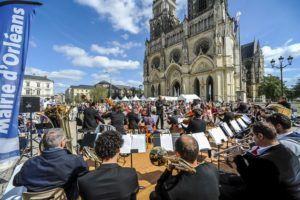 Rentrée en Fête 2023Orléans, FrancePlace du Martroi11 h 00Free entry
 -
11dec2022
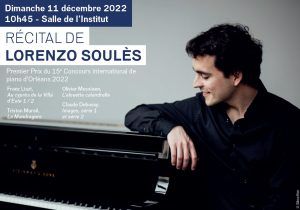 Matinée du piano – Lorenzo SoulèsOrléans, FranceSalle de l'Institut10 h 45On-site and online ticketing
 -
09oct2022
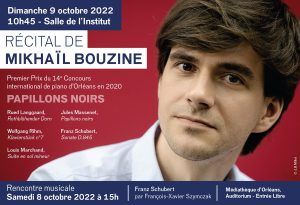 Matinée du piano – Mikhaïl Bouzine4 Place Sainte-Croix 45000 Orléans, FranceSalle de l'Institut10 h 45On-site and online ticketing
 -
11apr2022
 Concert of the laureates of the 15th CompetitionParis, FranceThéâtre des Bouffes du Nord20 h 30Tickets online
 -
10apr2022
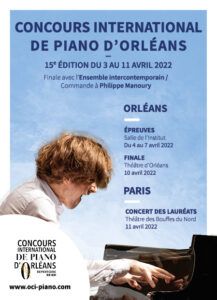 Final round of the 15th Competition with the Ensemble intercontemporainOrléans, FranceThéâtre d'Orléans15 h 00Tickets online
 -
09apr2022
 Concert of the soloists of the Orleans Symphonic OrchestraOrléans, FranceSalle de l'Institut19 h 00Tickets online
 -
08apr2022
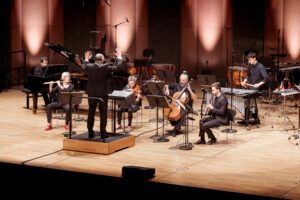 Concert of the Ensemble intercontemporainOrléans, FranceSalle de l'Institut19 h 00Tickets online
 -
07apr2022
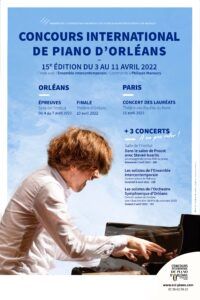 Semi-final recital of the 15th International piano competition of OrléansOrléans, FranceSalle de l'Institut9 h 00Ticketing on site
 -
05apr2022
First round of the 15th International piano competition of OrléansOrléans, FranceSalle de l'Institut9 h 15Ticketing on site and online
-
04apr2022
First round of the 15th International piano competition of OrléansOrléans, FranceSalle de l'Institut9 h 15Ticketing on site and online
-
04apr2022
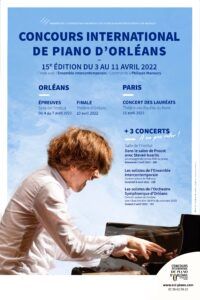 15th International piano competition of OrléansOrléans, FranceSalle de l'Institut / Théâtre d'Orléans
 -
03apr2022
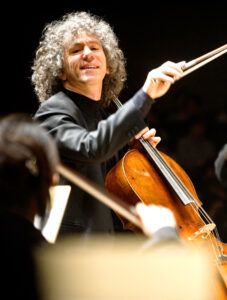 Opening concert of the 15th International piano competition of OrleansOrléans, FranceSalle de l'Institut18 h 00Tickets online
 -
02apr2022
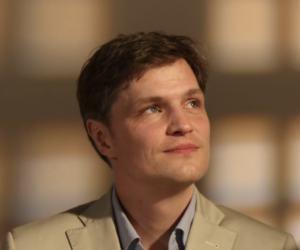 Conference by François-Xavier Szymczak “In Marcel Proust’s musical salon”Orléans, FranceMédiathèque d'Orléans11 h 00Free entry
© 2024 OCI Piano - Legal notices - Conception et réalisation Think Ad Communication